
How Do You See Colour Density?
If you’re a printer or photographic technician from the 1950s, it might be with a Kodak Densitometer.
The Kodak colour densitometer Model 1 was a simple, easy to use transmission densitometer specifically designed for making density measurements on colour and black-and-white photographic materials. It was intended for use by printers and process engravers and in laboratories and photo-finishing plants.
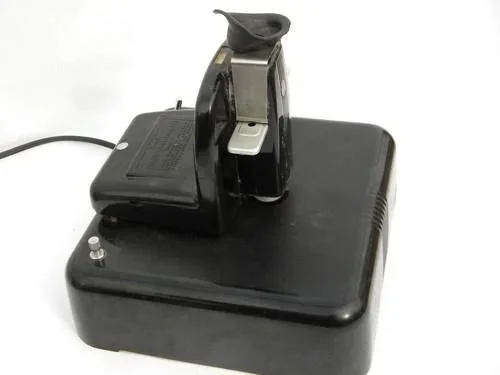
The densitometer could determine the black-and-white density at any point in a colour transparency, and could also measure the red, green, and blue densities by means of red, green, and blue filters built into the a holder in the eyepiece.
The measurements could be taken to the centre of a piece of film measuring up to 8 x 10 inches.
The optical system of the new densitometer was based on a new type of annular, rotatable density wedge made from clear stable plastic through which minute graphite granules were dispersed. The instrument was of the comparator type, was not affected by line voltage fluctuations, and there was nothing that could go wrong. An occasional check of the zero setting was all that was needed to give accurate readings.
The main application for the densitometer was for the standardization and control of the many photographic stages of colour reproduction. It was useful in making colour correction masks and colour-corrected separation negatives from transparencies, when masking from reflection copy using either overlay masking or magenta masking techniques, and in making colour prints either directly from positive or negative colour transparencies or in making matrices for dry transfer printing.
First published by Print Week as part of a series of columns entitled ‘Prints Past’.